%20(1).png)
Holly Springs City Council Tonight: What Every Resident Needs to Know
- May 4
- 8 min read
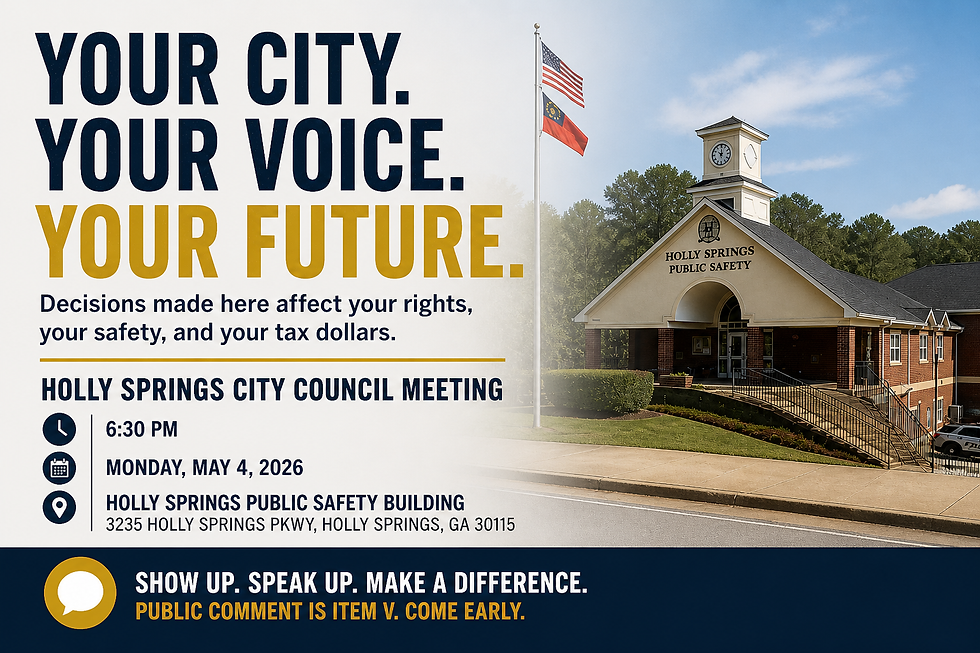
Holly Springs, your City Council Meeting is Monday, May 4, 2026 at 6:30 PM inside the Holly Springs Public Safety Building, located at 3235 Holly Springs Pkwy.
Agendas and agenda packets are downloadable at Holly Springs' civic portal here.
Whether you lean left or right, whether you are a lifelong Holly Springs resident or a newcomer drawn by the area's growth, tonight's city council meeting has something that should concern you. Local government decisions affect your property, your safety, and your tax dollars, and most of them get made with almost nobody watching.
Tonight is a chance to watch, learn, and speak up.
The Item Nobody Is Talking About: The Case That Has 60 Georgia Cities Terrified
Agenda Item VIII.A. is a resolution authorizing Holly Springs to join an amicus brief in Chang v. City of Milton, currently on remand before the Georgia Court of Appeals. Before you decide where you stand, you need to know the full story. Because this one is genuinely complicated.
What actually happened. On a November night in 2016, Joshua Chang, a 19-year-old Yale student, was driving home on Batesville Road in Milton, Georgia. Investigators found no evidence of speeding, intoxication, or distraction. A crash reconstruction expert concluded he likely swerved to avoid something in the road. His car left the pavement, crossed the shoulder, and struck a large, unmarked concrete planter that the City of Milton had placed within its own right-of-way. The impact flipped his car on top of the planter. Joshua died from his injuries.
City workers had previously observed the planter, and evidence of prior accidents near the location helped establish that the city had notice of the hazard. The planter was not some rogue object. It was there because the city put it there, or allowed it to remain, in a space where it had the legal responsibility to ensure public safety.
A Fulton County jury found Milton 93% at fault and awarded $32.5 million in damages to the Chang family. That is not a typo. And here is where things get genuinely complicated.
Why cities across Georgia are panicking. That $32.5 million verdict represents approximately 85% of the City of Milton's annual budget. Read that again. A single lawsuit, arising from a single incident, nearly wiped out an entire year of public revenue for an entire city. The Georgia Municipal Association describes this kind of verdict as a "nuclear verdict," and that is not an unfair description. If any Georgia city can face uncapped, budget-destroying liability for anything on their property at any time, the math becomes impossible for smaller communities. Insurance premiums explode. Budgets collapse. Taxpayers pay.
The potential for an entire year's budget to be at risk will shape how cities operate, and they will have little choice but to pass these added costs to taxpayers. That is a real concern, and dismissing it entirely would not be honest.
How the courts got here. The case has traveled a long road. The Georgia Court of Appeals initially affirmed the jury's verdict, concluding that Milton's sovereign immunity had been waived because the city has a ministerial duty to maintain streets in a reasonably safe condition, and that the planter constituted a defect in the public road of which the city had notice.
Then the Georgia Supreme Court stepped in. In a 5-2 opinion, the Supreme Court reversed the Court of Appeals and remanded the case, holding that the city's ministerial duty to keep streets safe for ordinary travel applies only to the lanes of travel themselves, not to areas outside those lanes, even if within the city's right-of-way. In other words, the Supreme Court gave cities a partial win: you cannot be sued under the ministerial duty theory for what happens in the shoulder or right-of-way.
That other source is the nuisance theory. And that is exactly what the Court of Appeals must now decide on remand. Can the Chang family still hold Milton accountable under a nuisance theory, a separate legal doctrine that has existed in Georgia since a 1968 case called Town of Fort Oglethorpe v. Phillips? Cities across Georgia, including Holly Springs tonight, want the answer to be no.
Two justices disagreed with the Supreme Court majority, and their dissent is worth understanding. Justices Verda Colvin and John Ellington argued that a municipality's duty to keep its streets and sidewalks safe extends to all parts of its municipal street system which are intended to be used by the public, and that because the planter was located on the shoulder of the road, an area that even the City admitted the public had a right to travel, the Chang family's claim should be allowed.
So where does that leave us? This is not a simple story of a callous government dodging accountability, and it is also not a simple story of runaway jury verdicts threatening public services. It is both things at once.
A 19-year-old Yale student died because a city left a large, unmarked concrete object in a place where someone could hit it in an emergency. The city knew it was there. A jury of regular people heard all the evidence and said the city was 93% responsible. That jury verdict matters. The Chang family deserves justice.
At the same time, the legal framework governing when cities can be sued in Georgia is genuinely murky, and the nuisance theory at the center of this remand is a judge-made doctrine that even the Georgia Supreme Court has questioned, rather than a clear legislative mandate from the General Assembly or the Georgia Constitution. The concern that unpredictable, open-ended liability could devastate small city budgets and ultimately harm the taxpayers and residents those cities serve is not invented. It is real.
Holly Springs wants to join a coordinated statewide effort by multiple cities to argue that the answer is no.
The resolution explicitly asks the city to take the position that no waiver of municipal sovereign immunity exists for nuisance-related personal injury claims. In plain English, here is what the resolution says: cities should not be held legally responsible when their negligence injures a resident.
And here is something that should make every resident sit up straight regardless of party: almost every nearby community has seen a similar resolution cross their city council agenda in recent months. We are not in the business of conspiracy theories, and we are not asking you to reach for a tinfoil hat. But when you see the same resolution, drafted in the same legal language, advancing through city councils across an entire region at roughly the same time, it is reasonable to ask who is coordinating this effort, who drafted the template, and whose interests are being served. What it looks like is people in power across North Georgia working in concert to protect the government by making it harder to hold them accountable when they make mistakes that hurt the governed. That is not a partisan observation. That is just what the pattern looks like, and residents deserve to ask the question out loud tonight.
If you are a conservative, this should give you pause. You believe in personal responsibility and property rights. Sovereign immunity is a doctrine that says government cannot be held accountable the way a private citizen or business can. Conservatives have long and rightly argued that government should be held to the same standards as everyone else. When a private contractor's negligence injures someone, they face consequences. Why should government be categorically different? Beyond that, this resolution commits Holly Springs to spending city resources, including your tax dollars, to intervene in litigation that is not even a Holly Springs case. That is not fiscal conservatism. That is using public money to protect government from accountability.
If you are a progressive, the concern is equally clear. Sovereign immunity has historically shielded powerful institutions from the consequences of their decisions, leaving injured residents, often working-class people who cannot afford prolonged legal battles, with no path to justice. When city infrastructure fails and someone gets hurt, that person deserves a remedy.
Where both sides should agree: Government accountability is not a partisan issue. It is a foundational American value. When your city spends your tax dollars to argue in court that it should face fewer consequences for harming you, that is worth a conversation.
What you can do: Come tonight. Speak during public comment, which is Item V, early in the meeting. Ask your council members why Holly Springs is joining this effort, whose idea it was, what it will cost, and whether the city has analyzed how this position affects Holly Springs residents, not just the city's liability exposure. You do not have to be a lawyer or a political activist to ask those questions. You just have to be a taxpayer.
The Routine Business: Worth a Look Anyway
VIII.B. The city received three competitive bids for traffic loop replacement near the Walmart on Holly Springs Parkway and is recommending the lowest bidder, North Cherokee Electrical, at $5,700. The other bids came in at $8,000 and $8,450. This is exactly how government procurement should work, and it is good news. Competitive bidding saves taxpayer money.
VIII.C. The city is renewing its pollution liability insurance coverage with GIRMA at $24,320, unchanged from last year. This coverage protects against contamination, chemical spills, hazardous waste, and mold claims. As Holly Springs continues to develop at a rapid pace, with construction activity across the city, this coverage is not optional. It protects residents and taxpayers alike.
VIII.D. Captain Michael Hales, a 10-year veteran of the Holly Springs Police Department, is being honored with the transfer of his service weapon upon departure in good standing. This is a standard and appropriate recognition of service.
The Financial Picture: Your Tax Dollars at Work
The agenda packet includes detailed financial reports through March 31, 2026. A few things stand out.
The spending gap. At 25% of the year elapsed, the General Fund has collected 11.28% of budgeted revenue but spent 18.32% of budgeted expenditures. Finance professionals will tell you this is normal in Q1 because property tax collections are backloaded. But it is worth watching through the year, particularly for residents who believe in balanced budgets and fiscal discipline.
The Town Center project. The city has budgeted $15.3 million this fiscal year in the Town Center Fund, including $10 million toward a new city hall and $2.5 million toward a parking deck. Construction has begun. Residents across the political spectrum have a legitimate interest in asking how these decisions were made, what the long-term debt picture looks like, and whether the community's priorities were reflected in those choices. Growth and investment can be good things, but they come with costs that fall on taxpayers for decades.
The URA fund balance. The Urban Redevelopment Agency is holding over $27 million in fund balance. The URA is technically a separate authority but is closely connected to city government. That is a significant pool of public resources, and residents deserve ongoing transparency about how it will be used and who has a say in those decisions.
SPLOST collections. Sales tax collections for infrastructure are running slightly ahead of budget pace, which means the road and infrastructure projects voters approved are moving forward on a sound financial footing. The Holly Springs Parkway widening and the new amphitheater are among the projects drawing down these funds.
A Word on Showing Up
There is a tendency to think of local government as boring or technical, something best left to insiders and regulars. That instinct is exactly what allows decisions like the amicus brief to sail through without public discussion.
You do not have to agree with everything on this page to show up tonight. You do not have to be a Democrat or a Republican or anything else. You just have to be someone who lives here, pays taxes here, and believes that elected officials should hear from the people they represent before they vote.
Public comment is early in the agenda, Item V. Arrive before 6:30 PM if you want to sign up to speak. The meeting is at the Holly Springs Public Safety Building, 3235 Holly Springs Pkwy, Holly Springs, GA 30115.
Your city council is making decisions tonight that affect your family, your property, and your rights. The most powerful thing any resident can do is simply be in the room.


Comments